Biography - Edited by RK Singh & RK Choudhry
As when a child falls asleep unawares
At a closed window on a stormy day,
Looking into the weary rain, and long,
Sleeps, and wakes quietly into a life
Of ancient moonlight, first the thoughtfulness
Of that felicitouaworld to which the soul
Is visitor in sleep, keeps her sublime
Discurtained eyes, human dismay comes next,
Slowly; last, sudden, they brighten, and grow wide,
With recognition of an alien world
Delighted: so woke Urvasie to love
The treatise in the above is an example of how much in depth does Sri Aurobindo transcend an emotion like love in Urvasie's awakening to love for Pururava.
See how much Priyumvada revels in love for Ruru:
how good it is to live, to love!
surely our joy shall never end, nor we,
Grow old, but like bright rivers or pure winds,
Sweetly continue, or revive with Flowers.
Or live atleast as long as senseless trees.
Love's labour won! But the victory is only a defeat in disguise. Both Pururava and Ruru failed in attaining love thus,
Born for the universe, they narrowed up their minds
And to themselves gave what was meant for mankind.
Our epics are filled with such valiant stories where Mankind has been the priority over everything else and all the personal fulfilments, including love become sublime. Lord Rama personifies the ideal so imposed.
Krishna will not come to Radha, she will now leap into the ocean and die_ in mockery, she says:
Die and be reborn into life again as Nanda's son
the joy of Braja's girls
And I will make you (Krishna) Radha then,
A laughing child's face set with lovely curls
Then I will love you and then leave
Then shall you know the bitterness of love.
see the beauty of form even in the translation from Bengali of Chundidas and it does not become less charming in English poetry.
Feel the pain! Feel love!
O heart, my heart, a heavy pain in you (love)
What land is that where none knows Love's cruel name
My heart, there let us go!
Wednesday, July 13, 2011

Tuesday, June 28, 2011
managerial lessons from RAMCHARITMANAS by Dr. N M Khandelwal
maṁgala bhavana amaṁgala hārī
dravahu sudasaratha acara bihārī
dravahu sudasaratha acara bihārī
Lord Rama, the destroyer of bad omens and harms and is the abode of harmony. So are our epics focusing on harmony and beauty which are termed as truth which is why it is referred to as 'satyam shivam sundaram'. ie., what is truth, is beauty and it is harmonius with Nature.

मंगल भवन अमंगल हारी
द्रवहु सुदसरथ अचर बिहारी
राम सिया राम सिया राम जय जय राम - २
द्रवहु सुदसरथ अचर बिहारी
राम सिया राम सिया राम जय जय राम - २
हो, होइहै वही जो राम रचि राखा
को करे तरफ़ बढ़ाए साखा
को करे तरफ़ बढ़ाए साखा
हो, धीरज धरम मित्र अरु नारी
आपद काल परखिये चारी
आपद काल परखिये चारी
हो, जेहिके जेहि पर सत्य सनेहू
सो तेहि मिलय न कछु सन्देहू
सो तेहि मिलय न कछु सन्देहू
हो, जाकी रही भावना जैसी
रघु मूरति देखी तिन तैसी
रघु मूरति देखी तिन तैसी
रघुकुल रीत सदा चली आई
प्राण जाए पर वचन न जाई
राम सिया राम सिया राम जय जय राम
प्राण जाए पर वचन न जाई
राम सिया राम सिया राम जय जय राम
हो, हरि अनन्त हरि कथा अनन्ता
कहहि सुनहि बहुविधि सब संता
राम सिया राम सिया राम जय जय राम
कहहि सुनहि बहुविधि सब संता
राम सिया राम सिया राम जय जय राम
- mukhia mukh so chaihe khan pan kahun ek
- palai poshai sakal ang tulsi sahit vivek
The ideal leader is like the mouth which eats alone but nourishes all limbs of body rationally. Thus, an ideal leader should be a trustee of resources provided by investors. He must be rational, just and fair to all stakeholders.
Wednesday, February 16, 2011
Enabling Execution Excellence G L O B A L A G E N D A by KB Akhilesh, Anjula Gurtoo & Gopal Mahapatra
Department of Management Studies, IISc, Bangalore and NIPM Karnataka chapter jointly presenting the 'International HR Conference' a series of papers presented in a Forum published by Himalaya Publishing House Pvt. Ltd.delve; s into those legends who believe in talent growth amongst employees. Here's to the success story that culminates in the strength of people power.
Bharat Petroleum Corporation: Industry - Petroleum; Faced deregulation of Petroleum Industry; Focused on redeployment and retaining of employees; Revamped Performance Appraisal System
Mahindra and Mahindra Ltd. Industry - Automobile (Tractor): Strategic Initiative - Rationalize manufacturing process: Flat structure that encourages team work; Outsourcing workforce for advanced and non-core activities
Maruti Udyog Ltd: Industry - Automobile Utility-Car segment: Strategy: launch new models, Increase dealer network, Reduce costs and increase operating efficiencies: Creation of excellent compensation policy
State Bank of India: Bank: Threats: Competition from foreign & private banks: Strategy - Trim the size of its workforce to rationalize costs, Introduced VRS to cope with automation
Arvind Mills: Textiles: Strategy - Recover from the change in fashion in the apparel Industry, Increase exports
Wipro Corporation: IT : Strategy - Sustaining the wealth of Human Capital; Introduced Employee Stock option schemes
Infosys: IT : Strategy - Employee driven campus programs like 'Infosys Toastmasters Club' to provide support to the employees - Leadership through INSTEP program where 3-6 months internships are given to students across the globe.
Ranbaxy: Pharmaceutical: Strategy - Backward integration , new drugs invention
TISCO : Steel : Strategy - Started PEP and revamped its PMS by aligning KRAs with strategy at all levels.
The Driving forces of the Society: India focuses on the Self/ Spirituality and China on its 'People'. On the Contrary, The Russia emphaiszes on 'State' while America is wholly 'Market' driven. Metaphorically, (India-China) and (America-Russia) would make the 'world-swastika' move. If there is harmony among the four forces, the world will experience synergy and happiness. The holistic Globalization hence depends on:
Force of Market, Force of State (or Government), Force of People & Force of Self (or Sprirituality).
Change Management
C=(DVF)>R
In this formula, Change is possible when the level of Dissatisfaction with the Status-Quo , the clarity of Vision, and the grasp of the First Steps to be taken can combine to be greater than the existing Resistance to change.
Kotter has suggested that there are eight factors that must be in place in order for a change to be successful.
1. Establishing a sense of urgency
2. Creating a guiding coalition
3. Developing a vision and strategy
4. Communicating the change vision
5. Empowering employees for broad-based action
6. Generating short term wins
7. Consolidating gains and producing more change
8. Anchoring new approaches in the culture.
The Quest for Balance
"One can live magnificiently in this world, if one knows how to work and how to love, to work for the person one loves, and to love one's work" - Leo Tolstoy
Bharat Petroleum Corporation: Industry - Petroleum; Faced deregulation of Petroleum Industry; Focused on redeployment and retaining of employees; Revamped Performance Appraisal System
Mahindra and Mahindra Ltd. Industry - Automobile (Tractor): Strategic Initiative - Rationalize manufacturing process: Flat structure that encourages team work; Outsourcing workforce for advanced and non-core activities
Maruti Udyog Ltd: Industry - Automobile Utility-Car segment: Strategy: launch new models, Increase dealer network, Reduce costs and increase operating efficiencies: Creation of excellent compensation policy
State Bank of India: Bank: Threats: Competition from foreign & private banks: Strategy - Trim the size of its workforce to rationalize costs, Introduced VRS to cope with automation
Arvind Mills: Textiles: Strategy - Recover from the change in fashion in the apparel Industry, Increase exports
Wipro Corporation: IT : Strategy - Sustaining the wealth of Human Capital; Introduced Employee Stock option schemes
Infosys: IT : Strategy - Employee driven campus programs like 'Infosys Toastmasters Club' to provide support to the employees - Leadership through INSTEP program where 3-6 months internships are given to students across the globe.
Ranbaxy: Pharmaceutical: Strategy - Backward integration , new drugs invention
TISCO : Steel : Strategy - Started PEP and revamped its PMS by aligning KRAs with strategy at all levels.
The Driving forces of the Society: India focuses on the Self/ Spirituality and China on its 'People'. On the Contrary, The Russia emphaiszes on 'State' while America is wholly 'Market' driven. Metaphorically, (India-China) and (America-Russia) would make the 'world-swastika' move. If there is harmony among the four forces, the world will experience synergy and happiness. The holistic Globalization hence depends on:
Force of Market, Force of State (or Government), Force of People & Force of Self (or Sprirituality).
Change Management
C=(DVF)>R
In this formula, Change is possible when the level of Dissatisfaction with the Status-Quo , the clarity of Vision, and the grasp of the First Steps to be taken can combine to be greater than the existing Resistance to change.
Kotter has suggested that there are eight factors that must be in place in order for a change to be successful.
1. Establishing a sense of urgency
2. Creating a guiding coalition
3. Developing a vision and strategy
4. Communicating the change vision
5. Empowering employees for broad-based action
6. Generating short term wins
7. Consolidating gains and producing more change
8. Anchoring new approaches in the culture.
The Quest for Balance
"One can live magnificiently in this world, if one knows how to work and how to love, to work for the person one loves, and to love one's work" - Leo Tolstoy
Monday, January 10, 2011
Business Intelligence by Amit Johri & A K Aggarwal
This is one book that is very contemporary and gives you a treatise of the dynamic wealth of opportunities to leverage Business through effective use of communication, technology, Analytics, Reporting, social networking, media .... and so on. There are a lot of interesting theories dealt with in the book that are seemingly fresh and comprehensible.
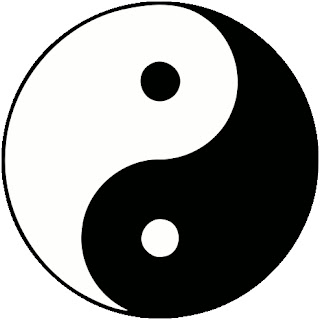 1. The Ying-Yang - Chinese Philosophy. The Yang-the white portion of the symbol represents movement, initiative, heat and fire. The Ying- the black portion of the sumbol represents passiveness, coldness and water. The Ying-Yang is a good symbol for Business-IT relationship. Even though, they are depicted as opposites, it also conveys "balance" and a duality that one cannot exist without other, which is why there is a small black dot in the Yang portion and vice versa.
The 4 C's Model - CONTENT, COLLABORATION, COMMUNITY & COLLECTIVE INTELLIGENCE which drive the modern Businesses.
The 4 Logical Groups - Digital Marketers (online marketing), Social Media (Micro-Blogging, Instant messaging, Public Relations via social web), Social Networks (Enterprise 2.0, RSS, Wiki) & Mass collaboration (crowd sourcing, ideagoras)
Cloud Computing: A style of computing where IT-related capabilities are provided "as a service" using Internet Technologies to Multiple External Customers
Cloud Models: SaaS (Software as a Service), DaaS (Data as a Service), Paas (Platfrom as a Service), Iaas (Infrastructure as a Service), IPMaas (Identity and Policy Management as a Service), Naas (Network as a Service)
Key Benefits:
1. Minimized Capital Expenditure
2. Location & Device Independence
3. Utilization and efficiency improvement
4. High scalability and sustainability
5. High-Level computing power
6. Increased reliability
7. Reduced opertional/maintenance cost
8. Portability/ Accessibility
9. Environment Friendly
Come! Experience the New Business World - on the throes of continuous Innovation, Greener Technologies & efficient Data Analytics that is gaining the priority it deserves.

The 4 C's Model - CONTENT, COLLABORATION, COMMUNITY & COLLECTIVE INTELLIGENCE which drive the modern Businesses.
The 4 Logical Groups - Digital Marketers (online marketing), Social Media (Micro-Blogging, Instant messaging, Public Relations via social web), Social Networks (Enterprise 2.0, RSS, Wiki) & Mass collaboration (crowd sourcing, ideagoras)
Cloud Computing: A style of computing where IT-related capabilities are provided "as a service" using Internet Technologies to Multiple External Customers
Cloud Models: SaaS (Software as a Service), DaaS (Data as a Service), Paas (Platfrom as a Service), Iaas (Infrastructure as a Service), IPMaas (Identity and Policy Management as a Service), Naas (Network as a Service)
Key Benefits:
1. Minimized Capital Expenditure
2. Location & Device Independence
3. Utilization and efficiency improvement
4. High scalability and sustainability
5. High-Level computing power
6. Increased reliability
7. Reduced opertional/maintenance cost
8. Portability/ Accessibility
9. Environment Friendly
Come! Experience the New Business World - on the throes of continuous Innovation, Greener Technologies & efficient Data Analytics that is gaining the priority it deserves.
Thursday, November 25, 2010
Human Resource Planning & Audit by Arun Sekhri
The whole book is very illustrative with a lot of case examples and SIMPLY SPEAKING.... tips given everywhere drawing your focus to the core concepts.
Mission Statements:
Microsoft: We work to help people and businesses throughout the world realise their full potential.
Ford Motors: We are a global family with a proud heritage passionately committed to providing personal mobility for people around the world.
Infosys: To make a difference to the way people live.
ITC Limited: To enhance the wealth generating capability of the enterprise in a globalizing environment, delivering superior and sustainable stakeholder value.
Mahindra and Mahindra: We don't have a group-wide mission statement. Our core purpose is what makes all of us get up and come to work in the morning.
ADIDAS : All Day I Dream About Sports
Unique Elements:
Siemens - Where Technology touches lives
Dupont: Better Things for Better Living though Chemistry
Hyundai: Building a better world through innovative technology
Nokia: Connecting People
Xerox: The Document Company
IBM: Solutions for a small planet
Philips: Let's make things better
BPL: Believe in the Best
FORD: Built for the road ahead.
EXXON MOBIL: Taking on the world's toughest energy challenges
CHEVRON: Finding newer, cleaner ways to power the world
AT & T : Your world delivered. Connecting you to your world, everywhere you live and work
Marriott International: "REVIVE"
AVON Products: Ding-Dong, AVON Calling
FEDEX: Relax, It's FedEx
Walt Disney: I am going to Disney World
3M : 'Innovation'
NIKE: If you have a body, you are an athlete
ABBOT Labouratories: A Promise for Life
BOEING: For-ever new Frontiers
Mission Statements:
Microsoft: We work to help people and businesses throughout the world realise their full potential.
Ford Motors: We are a global family with a proud heritage passionately committed to providing personal mobility for people around the world.
Infosys: To make a difference to the way people live.
ITC Limited: To enhance the wealth generating capability of the enterprise in a globalizing environment, delivering superior and sustainable stakeholder value.
Mahindra and Mahindra: We don't have a group-wide mission statement. Our core purpose is what makes all of us get up and come to work in the morning.
ADIDAS : All Day I Dream About Sports
Unique Elements:
Siemens - Where Technology touches lives
Dupont: Better Things for Better Living though Chemistry
Hyundai: Building a better world through innovative technology
Nokia: Connecting People
Xerox: The Document Company
IBM: Solutions for a small planet
Philips: Let's make things better
BPL: Believe in the Best
FORD: Built for the road ahead.
EXXON MOBIL: Taking on the world's toughest energy challenges
CHEVRON: Finding newer, cleaner ways to power the world
AT & T : Your world delivered. Connecting you to your world, everywhere you live and work
Marriott International: "REVIVE"
AVON Products: Ding-Dong, AVON Calling
FEDEX: Relax, It's FedEx
Walt Disney: I am going to Disney World
3M : 'Innovation'
NIKE: If you have a body, you are an athlete
ABBOT Labouratories: A Promise for Life
BOEING: For-ever new Frontiers
Wednesday, November 17, 2010
1857- Revisited A timeless journey: Myth and Reality
Rani Lakshmibai of Jhansi rose as an epic figure out of the national insurrection. She was only 22 years old in martyrdom and death on the battlefield which added to her popular image of herosim, reistance, boldness and insurgency. There is a telling song in folklore on how she raised her revolutionary army from the common people and made soldiers out of them
'From clay and stones
She moulded her army
From mere wood
She made swords
And the mountain she transformed
into a steed
Thus she marched to Gwalior!
The genius of Rani in countering the mass terror of the British is also depicted in folk poetry.
'Fell the trees
Commanded the Rani of Jhansi
Lest the Firanghis hang
our soldiers on them
So that the coward British
may not be able to shout
"Hang! Hand them in the trees!"
so that, in the hot sun
they may have no shade!'
Rani's leadership and level of self-confidence is reflected in this folk song:
'Amidst tears from his eyes
Proud Hugh Rose spoke
I beg you for one pot of water
To quench my thirst
with the first potful
and ask for more'
Replied Rani:
'To get that coveted pot
Hand over the guns,
and ammunition
and also your sword'
Mirza Ghalib on the loss of lives in the 1857 Mutiny:
"Sab kahan kuchh lala-o-gul mein numayaan ho gaye"
Some have turned into tulips and roses, where are the rest?
"Khaak mein kya sooratein hongi ke pinhaan ho gayein"
What beauteous shapes lie concealed beneath the shroud of dust!
"Yaad thi humko bhi ranga rang bazm aaraeaan"
I too revelled in colourful sessions in days of yore,
"Lekin ab naqsh-o-nigaar-e-taaq-e-nisiaan ho gayein"
But now they only serve to deck the oblivion's gloomy chest.
The spirit of the masses to sacrifice willingly their lives for the cause is amazing. Here the menfolk are being exhorted to go and bravely fight the British and be ready to have their heads smashed or sacrifice their lives. The womenfolk were ready to wipe their sindoor, symbolizing widowhood, but not willing their men to refuse to pick up the gauntlet. "The object of the mutineers were to wipe out all traces of Europeans, and of everything connected with foreign rule.
ba jan ganwai ke nevta
Churl forwai ke nevta
Sindoor pochwai ke nevta
Jai ho hamar te math del
Jai ho hamar te sath del
'From clay and stones
She moulded her army
From mere wood
She made swords
And the mountain she transformed
into a steed
Thus she marched to Gwalior!
The genius of Rani in countering the mass terror of the British is also depicted in folk poetry.
'Fell the trees
Commanded the Rani of Jhansi
Lest the Firanghis hang
our soldiers on them
So that the coward British
may not be able to shout
"Hang! Hand them in the trees!"
so that, in the hot sun
they may have no shade!'
Rani's leadership and level of self-confidence is reflected in this folk song:
'Amidst tears from his eyes
Proud Hugh Rose spoke
I beg you for one pot of water
To quench my thirst
with the first potful
and ask for more'
Replied Rani:
'To get that coveted pot
Hand over the guns,
and ammunition
and also your sword'
Mirza Ghalib on the loss of lives in the 1857 Mutiny:
"Sab kahan kuchh lala-o-gul mein numayaan ho gaye"
Some have turned into tulips and roses, where are the rest?
"Khaak mein kya sooratein hongi ke pinhaan ho gayein"
What beauteous shapes lie concealed beneath the shroud of dust!
"Yaad thi humko bhi ranga rang bazm aaraeaan"
I too revelled in colourful sessions in days of yore,
"Lekin ab naqsh-o-nigaar-e-taaq-e-nisiaan ho gayein"
But now they only serve to deck the oblivion's gloomy chest.
The spirit of the masses to sacrifice willingly their lives for the cause is amazing. Here the menfolk are being exhorted to go and bravely fight the British and be ready to have their heads smashed or sacrifice their lives. The womenfolk were ready to wipe their sindoor, symbolizing widowhood, but not willing their men to refuse to pick up the gauntlet. "The object of the mutineers were to wipe out all traces of Europeans, and of everything connected with foreign rule.
ba jan ganwai ke nevta
Churl forwai ke nevta
Sindoor pochwai ke nevta
Jai ho hamar te math del
Jai ho hamar te sath del
Thursday, November 11, 2010
The Power of Managing Time by J D Tripathi
There has been a lot written about Time Management. But, when I read the reviews of Javed Akhter and Shobhaa De on this book, I knew this has to be special. I started reading and I could not put the book down. The treatise is succint and clear.
The Beginning: Voltaire's question: "What of all things in the world, is the longest and shortest, the swiftest and slowest, the most divisible and most extended, the most neglected and most regretted, without which nothing can be done, which devours all that is little, and enlivens All that is Great?" The answer is TIME
He has formulated a Time spectrum which focuses on Reducing -Unnecessary/ non-productive work/ Procrastination, Interference interruptions and Utilization of Thinking Time for planning/ meditation, productive work, recreation to recoup oneself. Idle time, waiting time and travel time needs to be managed with as much positive approach to make your day worthwhile.
The only reason for time is so, that everything doesn't happen at once". - Albert Einstein
"Of calculators, I am Time, the imperishable, world-destroying, grown mature, engaged here in subduing the world". - Dr. S Radhakrishnan quoting the Bhagawad Gita.
You cannot kill time without injuring eternity - Thoreau
Conclusion:
Story of Time: Somewhere in the far East, there lived a King who wanted to gift the most precious thing to his subjects. In one of this trips, he came across a Sundial which he brought home and installed it at the City Centre.
His subjects started to differentiate the parts of the day, they became time-conscious, produced more and prospered.
Eventually, the King died. The subjects wanted to pay tribute to the King and so they built a temple around the sundial andornated it with gold and jewels. It was a fitting tribute to the King who brought the Sundial.
The rays no longer reached the sundial: the shadow that was the source of prosperity was not longer in time/ they lost their orientation. The kingdom collapsed. (Source: I J T D, ISTD, New Delhi)
Now, give it a thought!!
The Beginning: Voltaire's question: "What of all things in the world, is the longest and shortest, the swiftest and slowest, the most divisible and most extended, the most neglected and most regretted, without which nothing can be done, which devours all that is little, and enlivens All that is Great?" The answer is TIME
He has formulated a Time spectrum which focuses on Reducing -Unnecessary/ non-productive work/ Procrastination, Interference interruptions and Utilization of Thinking Time for planning/ meditation, productive work, recreation to recoup oneself. Idle time, waiting time and travel time needs to be managed with as much positive approach to make your day worthwhile.
The only reason for time is so, that everything doesn't happen at once". - Albert Einstein
"Of calculators, I am Time, the imperishable, world-destroying, grown mature, engaged here in subduing the world". - Dr. S Radhakrishnan quoting the Bhagawad Gita.
You cannot kill time without injuring eternity - Thoreau
Conclusion:
Story of Time: Somewhere in the far East, there lived a King who wanted to gift the most precious thing to his subjects. In one of this trips, he came across a Sundial which he brought home and installed it at the City Centre.
His subjects started to differentiate the parts of the day, they became time-conscious, produced more and prospered.
Eventually, the King died. The subjects wanted to pay tribute to the King and so they built a temple around the sundial andornated it with gold and jewels. It was a fitting tribute to the King who brought the Sundial.
The rays no longer reached the sundial: the shadow that was the source of prosperity was not longer in time/ they lost their orientation. The kingdom collapsed. (Source: I J T D, ISTD, New Delhi)
Now, give it a thought!!
Subscribe to:
Posts (Atom)